Quick Answer: Trenchless pipe bursting is a no-dig pipe replacement method that pulls a new pipe through an old one while a bursting head breaks the existing pipe outward into the surrounding soil. It typically needs two small access pits, avoids long trenches, and can even upsize the pipe to improve flow. It’s often used for damaged sewer lateral lines made of clay or cast iron, especially where yards, sidewalks, and driveways are hard to disturb. A camera inspection (CCTV) usually confirms the pipe condition and layout first. The result is a long, continuous replacement pipe commonly HDPE installed with minimal surface disruption.
When Pipe Bursting Makes Sense (And When It Doesn’t)
The Benefits of Pipe Bursting Over Traditional Methods can be huge when your sewer line runs under landscaping, concrete, mature trees, or hardscapes you don’t want torn up.
Pipe bursting is typically considered when:
- The line needs full replacement, not a patch.
- The existing pipe has cracks, leaks, deformation, or heavy root intrusion.
- You want to avoid open-cut excavation across a yard, driveway, or sidewalk.
- You want an option to upsize a restrictive line (when site conditions allow).
Pipe bursting is often used for sewer line replacement, sanitary sewer line work, and water line projects. In many residential cases, the target is the sewer lateral line (house-to-main lateral).
Quick tip: If backups happen only during storms, check surface drainage first (yard grading and curb drains) before assuming the sewer is failing. Heavy rain can overload older systems and reveal weak points fast.
What Pipe Bursting Is (Simple Definition)
It’s a trenchless technology that replaces an underground pipe by pulling a new pipe through the old one while a cone-shaped expansion head fractures the existing pipe and displaces fragments into the surrounding soil.
This approach is different from repair-in-place options because it replaces the pipe rather than coating it. Key components you’ll hear about:
- A bursting head (also called a cone-shaped expansion head)
- A steel cable or pulling rod system
- A winch system
- A hydraulic unit (for static pull) or compressed air (for pneumatic)
- A continuous replacement pipe, often high-density polyethylene (HDPE) pipe or polyethylene that’s fully fused (minimal joints)
When a sewer failure escalates into an active rupture or sudden wastewater release, knowing how to handle burst pipes becomes critical before any long-term replacement decision is made. Immediate steps like shutting off water flow, avoiding drain use, and preventing sewage contact can limit structural damage and health risks while inspections are scheduled. Once the situation is stabilized, trenchless pipe bursting may be evaluated as a permanent solution if the line is beyond repair.
Types of Trenchless Pipe Bursting (Static vs Pneumatic)
There are two common classes of pipe bursting:
Static Pipe Bursting (Static Pull System)
Static systems use a hydraulic unit to apply a steady pull force through the line. The bursting head moves forward with controlled power, which many crews prefer for predictable progress in sensitive areas.
Pneumatic Pipe Bursting
Pneumatic systems use compressed air to drive the bursting tool. Think of a powerful percussive action that advances through the old pipe, fracturing it.
Both are forms of the pipe bursting technique, and both still rely on the same basic physics: break old pipe outward, pull new pipe into the created path.
Trenchless vs Traditional Repair Options (Clear Comparison)
Below is a practical comparison that homeowners and property managers actually care about.
Trenchless Options vs Open-Cut Excavation
| Method | What It Does | Best For | Trade-Offs |
| Open-cut excavation (traditional trenching) | Dig trench, remove pipe, install new | Severe collapses, complex reroutes | High restoration cost, surface disruption |
| Pipe bursting | Breaks old pipe outward while pulling new pipe | Full replacement, upsizing, clay/cast iron | Not ideal for some materials/conditions |
| Cured-in-Place Pipe (CIPP) | Inserts resin liner; cures pipe within a pipe | Cracks, leaks, corrosion without collapse | Reduces diameter slightly; needs good host pipe |
| Slip lining | Inserts smaller liner pipe and grouts annulus | Structurally stable pipes needing reinforcement | Reduces flow capacity more than CIPP |
You may also hear pipe splitting discussed; it’s related but used in narrower scenarios.
Step-by-Step: How the Pipe Bursting Process Works
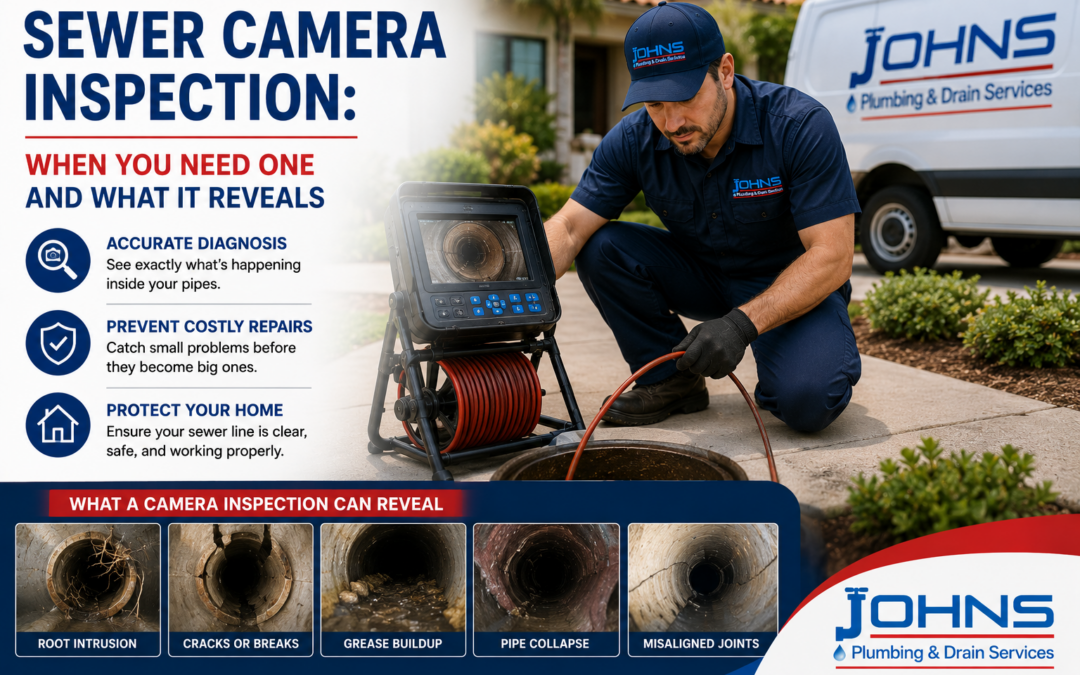
Before any trenchless work begins, a sewer camera inspection is typically performed using a high-resolution video camera. This confirms alignment, defects, depth changes, and whether the pipe is collapsed.
The Pipe Bursting Process (Typical Sequence)
- Initial inspection and diagnosis: CCTV camera run, defect mapping, and location confirmation.
- Plan access points: Two compact entry pits & exit pits (access pits) are selected.
- Create pits: Often called pulling pit and insertion pit.
- Feed pulling cable: A steel cable is run through the old pipe to the insertion side.
- Attach bursting head + new pipe: A bursting head is connected to the cable and the new pipe (often HDPE).
- Burst and replace: The winch pulls the head through; old pipe fractures outward; new pipe follows.
- Reconnect and seal: Ends tie back into existing plumbing; service connections are handled as needed.
- Quality assurance: Post-work CCTV confirms grade, flow, and integrity.
For homeowners who encounter sudden failures instead of gradual deterioration, understanding what to do if a pipe bursts can prevent minor pipe damage from turning into widespread property loss. Emergency actions like stopping the water flow, draining the system, and controlling moisture are critical first steps, but they don’t address the underlying condition of aging sewer pipes. In these cases, trenchless pipe bursting may be considered after stabilization to replace the failed line without extensive excavation.
What New Pipe Is Used (And Why HDPE Is Common)
Most modern pipe bursting installs use high-density polyethylene (HDPE) pipe because it’s strong, flexible, corrosion-resistant, and can be installed as a fully fused polyethylene run with minimal joints.
You may also hear about:
- PVC pipe (used in some contexts)
- Replacement of older clay pipe and cast iron pipe
- Special consideration for ductile iron and reinforced concrete pipe (bursting feasibility depends on condition and method)
Tip: A continuous fused pipe can reduce leak risks that sometimes develop at multiple joint points over decades.
Sizing, Diameter, and Upsizing (The Real Performance Upgrade)
Sometimes you can install an equal or slightly larger diameter pipe to improve flow capacity.
Common residential laterals are often in the 4-6 inch range, but feasibility depends on clearance, depth, and soil displacement tolerance. On larger utility work, diameter ranges can be wider (you’ll see references like 100–600 mm / 4-24 inches in industry discussions).
Important concept: Upsizing increases soil displacement, and that’s where ground heave risk comes into play especially in stiff soils and shallow installations.
Suitability Checklist (Pipe, Soil, Depth, Utilities)
Pipe bursting trenchless technology works best when the pipe path is reasonably consistent and the soil can accept displacement without causing surface issues.
Suitability Factors for Pipe Bursting
| Factor | What Good Looks Like | Red Flags |
| Pipe condition | Cracked, leaking, deformed but still has a path | Fully collapsed with no pilot path |
| Pipe material | Clay pipe, cast iron pipe often workable | Some ductile iron / reinforced concrete challenges |
| Soil conditions | Stable soils that can accept displacement | Highly sensitive soils, shallow cover risk |
| Nearby utilities | Mapped, protected, coordinated | Unknown crossings, congested corridors |
| Depth | Enough cover to reduce surface heave | Very shallow lines under brittle hardscape |
| Access | Room for pits and equipment | Zero room for pulling/insertion pits |
Final approval for pipe bursting should come from certified pipe bursting experts who can interpret CCTV data, soil displacement tolerance, and pipe material behaviour together. Their certification ensures the bursting head size, pulling force, and replacement pipe selection are matched correctly to site conditions, reducing risks like ground heave or incomplete pipe fracture.
Pipe Bursting Limitations You Should Know Up Front
Pipe bursting limitations are real, and understanding them prevents bad outcomes.
Common constraints include:
- Fully collapsed pipes (may require prep work or alternate approaches)
- Severe misalignment, sags, or bellies that disrupt pulling
- Tight bends that the bursting head can’t navigate safely
- Highly congested utility corridors where displacement risk is too high
- Edge cases with pipe materials that don’t fracture predictably
Tip: If your pipe has severe grade issues, replacing in the same path might not solve the underlying drainage physics. Sometimes regrading or rerouting is required.
What It Feels and Sounds Like During Work (Noise, Vibration, Disruption)
It often sounds like a steady mechanical pull with intermittent cracking or thudding, especially with pneumatic systems some homeowners describe as distant hammering or rumbling beneath the ground.
You may also notice mild vibration near pit areas. Most of the visible disruption is limited to the access pits, not a long trench.
If you’re dealing with a sewage pipe burst emergency (active sewage release), stop water use when possible and prioritize safety. Sewage exposure is a health hazard and can damage flooring, drywall, and foundations quickly.
Safety, Prep, and Before You Start Planning
Licensed plumbing experts will usually coordinate utility locates, plan bypass needs, and set expectations for access, noise, and reconnection timing.
Prep Checklist
- Confirm the issue with CCTV camera inspection and a written findings report.
- Identify all crossings: gas, water, electric, telecom, irrigation.
- Decide whether a temporary bypass line is needed for service continuity.
- Verify pit locations (pulling pit/insertion pit) and access constraints.
- Confirm the replacement pipe plan (HDPE fusion, length, reconnection points).
Quick fix (storm-season edition): If backups spike after rain, clear yard drains and curb grates and verify downspouts aren’t dumping near the foundation surface, water can reveal weak sewer laterals fast.
How Trenchless Compares on Time, Cost, and Restoration
The biggest homeowner benefit is often restoration, not the pipe itself. Traditional open-cut excavation can mean redoing concrete, landscaping, irrigation, and sometimes traffic disruption.
Why homeowners like trenchless
Less surface damage to yards, hardscape, and driveways
Faster completion in many cases
Lower restoration cost and less downtime
Option to upsize for better flow capacity
At the same time, trenchless isn’t magic site constraints, soil conditions, and utilities can raise complexity.
After Installation: Reconnection, Testing, and Long-Term Care
Once the new pipe is in place, crews reconnect and secure both ends. On complex lines, service connections may be reopened with specialized tools (including robotic cutters in certain rehabilitation contexts).
Post-Work Verification
- Final CCTV confirmation: alignment, grade, and flow
- Check for cleanout accessibility and sealing
- Verify reconnections and monitor for leaks
- Confirm no surface settlement around pits
- Establish do’s and don’ts for the first week (no heavy loads over fresh backfill)
Habits that protect the new line
- Keep grease and wipes out of drains
- Address root-prone landscaping near laterals
- Schedule periodic camera checks in older neighbourhoods
- Fix minor clogs early before they become structural stressors
Call Johns Plumbing & Drain Services for Trenchless Help
If your sewer line is failing and you want a clear, inspection-based plan (not guesswork), John’s Plumbing & Drain Services can help you confirm the problem with a camera inspection and explain the best path forward, trenchless or otherwise. Call now: 3234227485 to schedule an evaluation and get your sewer system back to reliable flow with minimal disruption.
FAQs About Trenchless Pipe Bursting
No pipe bursting replaces the pipe by fracturing the old one outward and pulling in a new pipe, while CIPP creates a pipe within a pipe liner inside the existing host pipe.
Sometimes upsizing is possible when soil cover and site conditions can safely handle the extra displacement without causing ground heave.
It can be, especially for clay and cast iron, but it depends on condition, alignment, depth, and nearby utilities camera inspection is the deciding step.
Usually far less than open-cut excavation because the work focuses on two access pits rather than a continuous trench across the property.
Often a mix of steady pulling and intermittent cracking/thudding (more noticeable with pneumatic systems), typically localized near the pits.
Severe collapses that prevent tool passage, major alignment/grade failures, tight bends, shallow cover risk, or sensitive/congested utility corridors.