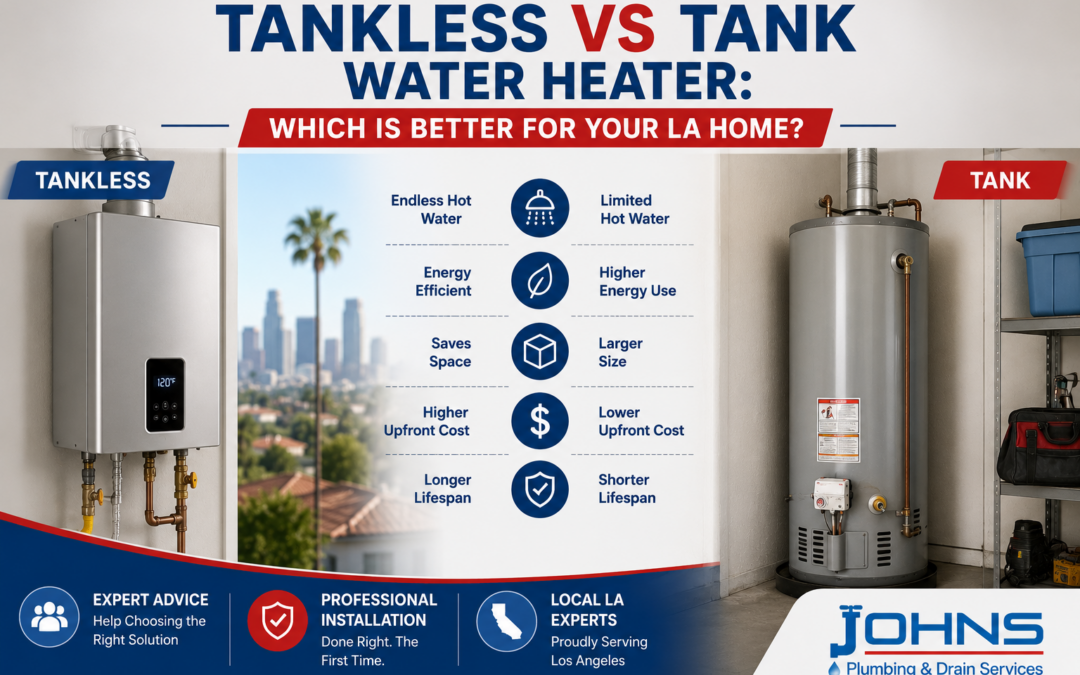
Quick Answer: For most Burbank and Los Angeles homeowners, a tankless water heater is worth the investment if you plan to stay in your home for five years or longer. The higher upfront cost is offset by energy savings of 24 to 34 percent, a lifespan double that of tank units, unlimited hot water, and freed-up floor space. The main cons are higher installation cost, the need for annual descaling in hard water areas, and potential gas line upgrades.
The pitch sounds almost too good. Endless hot water. Lower energy bills. A unit that lasts twice as long. Takes up less space than a suitcase. So what is the catch? Is a tankless water heater actually worth the money, or is it overhyped?
The honest answer depends on your household, your home, and your timeline. Here is the full breakdown.
The Pros
Unlimited hot water. A tankless system heats water as it flows through the heat exchanger, so it never runs out. Back-to-back showers, a dishwasher and a washing machine running simultaneously, filling a large soaking tub without running cold partway through. For families, this is usually the single biggest selling point.
Energy efficiency. The U.S. Department of Energy estimates that tankless water heaters are 24 to 34 percent more energy efficient than conventional tank units for homes using 41 gallons or less per day. Tank heaters maintain 40 to 50 gallons of hot water 24/7 whether you need it or not. Tankless systems only consume energy when you turn on a hot tap. That standby heat loss adds up to real money over a year.
Longer lifespan. A quality tankless unit lasts 20 years or more compared to 8 to 12 for a tank heater. If you are planning to stay in your Burbank home long-term, the longer lifespan alone closes much of the upfront cost gap.
Space savings. A tankless unit mounts on a wall, often on the exterior of the home. It is roughly the size of a small suitcase. For Burbank homes where garage space is at a premium, removing a bulky 40-gallon tank and freeing up nine square feet of floor space is a genuine benefit.
Reduced flood risk. Tank water heaters are one of the most common sources of residential water damage. When a tank fails, it dumps 40 to 50 gallons of water onto your floor. A tankless unit has no reservoir, so there is no catastrophic tank failure risk.
The Cons
Higher upfront cost. A tankless installation typically costs $3,000 to $5,000 including the unit, gas line upgrades, and new venting. A standard tank replacement runs $1,200 to $2,000 installed. The price gap is real and cannot be ignored.
Gas line and venting requirements. Most tankless units require a larger gas supply line than what feeds a standard tank heater. If your existing gas line is undersized, the plumber will need to run a new line from the meter to the unit. Venting requirements also differ, as tankless systems require dedicated stainless steel venting rather than the standard B-vent used by most tank heaters. Both of these factors add to the installation cost.
Annual maintenance in hard water areas. In Los Angeles, where hard water is a reality, a tankless unit requires an annual vinegar flush to remove mineral scale from the heat exchanger. Skipping this maintenance reduces efficiency and can eventually damage the heat exchanger, which is expensive to replace. Tank heaters need annual flushing too, but many homeowners neglect it without immediate consequence (until the tank fails prematurely).
Cold water sandwich. Some homeowners experience a brief burst of cold water between hot water draws, called a cold water sandwich. This happens when someone uses hot water, stops, and then turns it on again shortly after. The water sitting in the pipe between the tankless unit and the fixture cools during the brief pause. Recirculation systems can eliminate this, but add to the installation cost.
The Math
If your current tank heater costs roughly $45 per month in gas to operate, and a tankless unit reduces that by 30 percent, you save about $162 per year in energy costs. Over 20 years, that is $3,240 in energy savings alone. Add in the avoided cost of replacing a second tank heater (since tankless lasts 20 years instead of 10), and the lifetime cost of ownership tilts strongly in favor of tankless for homeowners who plan to stay put.
If you are selling the home within a year or two, the upfront cost may not pencil out. But a tankless water heater is also a marketable upgrade that buyers in the LA market recognize and value.
Making the Decision
Talk to a licensed plumber who installs both tank and tankless systems. A good plumber will evaluate your gas line capacity, hot water demand, and installation logistics before recommending one over the other. The right answer is different for every home, but for most Burbank and LA households, tankless is the better long-term investment.
FAQs
Can a single tankless unit serve a whole house? Yes, if it is properly sized for your household’s peak hot water demand. A plumber calculates the number of fixtures likely to run simultaneously and recommends a unit with the appropriate flow rate. Oversizing slightly is better than undersizing.
Do tankless water heaters work during a power outage? Gas tankless units require electricity to ignite and operate the control board. Without power, they will not function. A battery backup or a small generator can keep the unit running during outages.
What brands do Los Angeles plumbers recommend? Rinnai and Navien are the two most commonly installed residential tankless brands in the LA area. Both offer strong warranties, reliable performance, and readily available replacement parts.
How long does a tankless installation take? A straightforward swap from tank to tankless, including gas line and venting work, typically takes one full day. Complex installations with long gas line runs or difficult venting routes may extend to a day and a half.